Thursday, December 8, 2016

24. PIANOS AND CLOCKS

I have mentioned before that I try to recycle items that I used in previous projects. This is difficult mainly because many of the earlier items in my collection were not created with skill.

However, two items that I am proud of reappeared in Zann's room. These are the grandfather clock, and the piano. Both items were initially created for my second animated short, "Painting with my Sister." (I also reused them in the postponed video game "Homeless Guy;" the clock makes an important appearance in our successful video game "The Elf Who Killed Christmas.") I suppose that there are details from both items that I would change if I were to recreate them, but for now, they suited their purpose as background set dressing.

One thing that I added to the piano was sheet music that sat on upon the piano, thus giving a bit more detail. Also, imagining the cluttered nature of Zann's room (and psyche), I tried to put more and more items of clutter upon the piano, as though it was also a piece of furniture.

Given the role that music would play in this piece, there were times when I considered using the piano as the instrument that Zann would perform on. There were a couple of reasons for this. First is that I already had the piano, and thus wouldn't need to create an additional instrument. Second, I knew that performing on a piano would be much easier to animate than performing on a guitar (which I ultimately chose), or a viol (which is the instrument in the story). The third reason for considering the piano as Erich Zann's musical instrument is that I knew it would be easier to create or record piano music than guitar music (which is a pain to record), or a viol (which I don't have access too); even using midi generated music, there are much better sounding solutions for piano synthesis than for guitar or viol (or violin) synthesis. (I will discuss these last two issues in more detail later.)

Despite these three good reasons for choosing Zann to play the piano, I decided against this. Ultimately, it was an aesthetic decision that the final scene could not be realized with him playing a piano. However, there was still room for a piano to sit in the corner of his room. (The alarm clock is hardly seen, but since I talk about clocks here, this seemed like a nice place to show it.)


Website:  Contacts:       and the film: 

Tuesday, December 6, 2016

23. STUFF NEVER SEEN

Looking back at the foyer set, and Erich Zann's room, it seems to me now that many items were modeled did not make any appearance in the final film, not even blurry in the background. I remember reading an article by animators who complained about such methods. That is, I worked to create a world, but not a film.

If I were working to create a film, I should have worked based on reference from the screenplay or storyboards to discover what the scene really needed in order to fill the frame, not fill the apartment. Of course, I can defend myself, but I won't do that here. Rather, the point of this complaint is that I worked much harder than I needed to; I spent a lot of energy and time making items that were not needed for the film. I must acknowledge that this is a serious problem; it would be a much more serious problem for a professional animator who was being paid by someone to work. That costs energy, time, computer resources, and money! Perhaps my method of working is only one way that my amateurism is different from professionals.


Website:  Contacts:       and the film: 

Monday, December 5, 2016

22. ZANN'S FURNITURE

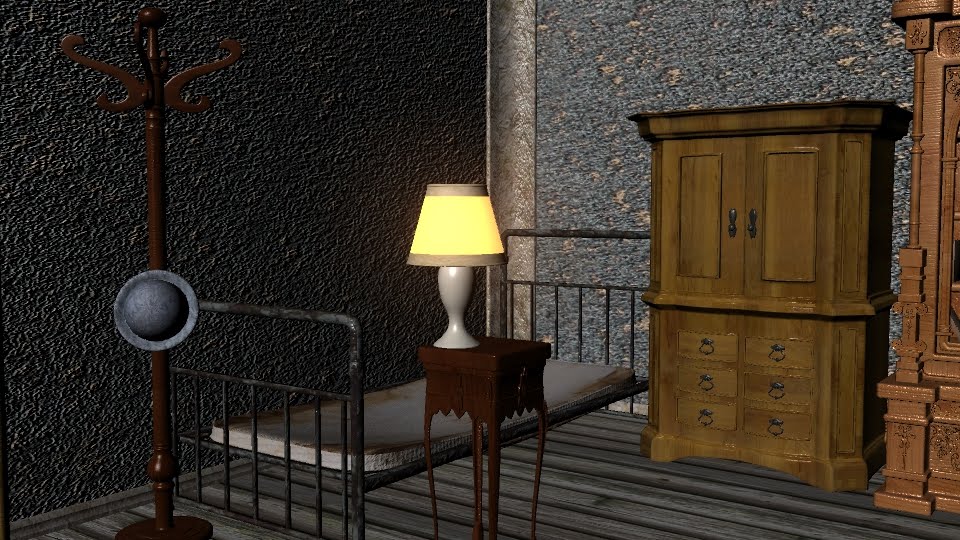
To illustrate Zann's age, I wanted to also give him old, ornamental furniture. I spent a lot of time adding such detail to his armoire and cabinet. In order to do this, I researched ornamental design, and found lots of black-line illustrations that I could simply trace over in order to create ornamental geometry. I then slapped this ornamental geometry on top of the furniture where I could. Because this was a tedious process, I only did it twice, with two ornamental designs, and then repurposed the same geometry, perhaps edited in different ways, for different places. This is similar to how I designed the stair rails in the foyer. (This is also how I created the vent covering for both of the rooms; but I didn't decide to add that element until much later in production.)

(One might also notice that the handles on the cabinet were also repurposed as door knockers around the world.)

Having designed such a detailed armoire, I needed to fill it with stuff. (Looking back, I don't think that I filled it with enough clutter.) The obvious solution in my mind were books. I had already created books for a previous project, so I was able to bring those in. Another important element that I want to be sure to include in all of my projects is from my first video game, Alpha Chimp. The only nice thing that I modeled for that project (it was created towards the end of that project, after I my modeling skills were further along), was the main boss of the game, the Alpha Chimp. How I decided to incorporate that here was to include it as a paper weight statue on the armoire. And again, I also repurposed the flowers from the foyer.

I remember thinking that an old man should probably have photographs of friends and family in his home. But I ultimately decided against that because I felt that would take away from his sense of loneliness and solitude. Writing this now, I might regret that decision; perhaps the photographs would have actually lent more sympathy for Zann....


Website:  Contacts:       and the film: 

Thursday, December 1, 2016

21. ZANN'S ROOM

When designing the individual rooms for the two characters in "TheMusic of Erich Zann," I wanted there to be a stark difference, yet still give a sense of the derelict aesthetic that I was initially going for in the foyer of the building. I imagined, perhaps, that the landlord kept up the surface appearance, but didn't care much for the tenants. And thus, the tenants happened to be whomever the wind blew in.

That said, I still wanted Erich Zann's room to give the impression of an old man who has lived a full life, but has lost control of his life, and his possessions. I hoped that the boarded up windows would give this impression, in addition to the clutter filled table. Reflecting back on these words, I am not sure that I actually achieved this impression for the whole environment, but this was my thinking. (Next time, I will remember to reveal more clutter, and debris in the room and on the floor to better achieve such an effect.)

(By the way, this same pieces of wood that cover the windows also make an appearance in the exterior scene. These were added later in the production, when I felt that there had to be more clutter outside of the building.)

Another way to add to this disheveled life was how I incorporated the water closet. In line with the notion that these rooms were cheap, despite the building's nice facade, the rooms would be simple studios that don't even have separate rooms for the water closet; the toilet, sink, and bath would all be in the same space. For the student's room, I would at least give her a curtain around this bathroom, but in Zann's room, I wanted to show that he lacked the sense to even separate his life from such things, thus leaving all of this filth out for viewer to see. However, like the furniture in the foyer, I designed these sets without any screenplay or storyboard in hand. Thus, I don't think that this water closet (in either room) is seen in any shot in the finished film. (Looking back, it's probably a good thing that it wasn't seen because I didn't take the time to texture the porcelain as though it was dirty, or unclean.)

One last piece to show the drabness of the environment was the bed. Like the water closet, Zann's bed barely appears in the final product (though I do think we might see it out of focus in the back of a few shots.) However, the crusty bed does make an appearance in the student's room.


Website:  Contacts:       and the film: 


Tuesday, November 29, 2016

20. CAMERA

Getting feedback of these early shots was very important in the further development, and making "The Music of Erich Zann" a better film. This went for the sets, and characters, but also rendering techniques. I showed a friend an early image, and he quickly saw the improvement over my previous projects, but also lamented about some rendering elements. He was a photographer, so on those early shots, he only talked to me about photography. Here, when I say photography, he wasn't even talking too much about image composition, but rather about the mechanics of techniques of using a camera. These were all new ideas to me, and things that I had never considered before. To be sure, I have other friends who are photographers, but it is sometimes difficult for people to talk about and explain their art, or their medium; my friend here had no problem with that, and told me about many interesting photographic features that I should incorporate in order to make a more compelling image.

As I stated before, I am still quite a novice when it comes to rendering issues, but after some online research, I did figure out how to include lens flares and depth of field to the cameras in the scenes. (There is a ton more stuff that I left out and that I've still yet to learn, but for now...)


Website:  Contacts:       and the film: 

Monday, November 28, 2016

19. EARLY RENDERS

During Christmas, I was at a friend's holiday party, when the discussion of animation came up. We were all watching my favorite Christmas film (and my favorite animated film, and probably one of my favorite all-time films) The Nightmare Before Christmas. I must have watched that movie hundreds of times in my life, and dissected many of the key elements of the film.

In any case, when the discussion turned to animation, I shared that I am an animator, and that I was currently working on a short film. However, I didn't have anything to show my new friend. She just had to take for granted all of the weird things I was telling her. Since animation is essentially a visual medium, I should have a visual example to share with discussing my work. This might seem odd, except that I always carry with me an iPad so that I can read (or a smart phone that has the ability to share images or movies). (The careful reader will notice that in an earlier post I slammed Mac computers for their inefficient OSX that doesn't run 3D applications well; to be sure, I love Apple toys (iPhones and iPads), it's just their computers that I think are terrible.)

I'm telling you all of that so I can tell you this. I then began rendering still images as I could, and carried them with me, or shared them on social media (a little bit). Like I said earlier, I don't like promoting a project before it is complete, because if I don't complete it, then I dislike the character that makes of me. However, I was willing to share stills here and there with certain people. This was a big change for me, because in my previous projects, I didn't share anything until the final product was complete. The problem with such a strategy is that by that point, it is too late to fix or correct problems. Thus, for the first time, I was opening myself up to criticism and asking for feedback so that I might change things and better them while still in the production process.


Website:  Contacts:       and the film: 


Tuesday, November 22, 2016

18. TOO MANY LIGHTS

When setting out writing this blog, I had hoped to tackle production issues more or less in the order that they were faced. However, I suppose that now is as good as ever to discuss the rendering issues for the foyer.

The first obvious issue is that the polygon count was ridiculous. This always seemed to increase because I insisted on an ornamental style. This goes for the arches, as well as the columns that held the walls up. I could have made the Greek columns relatively simple, but instead I went for the more complex Corinthian style columns. This meant that I had to model all of the ornamental details at the pedestal of the column.

But I later discovered that the greatest challenge for rendering the scenes in the foyer was the lighting. To be sure, as much as I complained about my lack of skill with texturing, I have so much less understanding of rendering and lighting. I've read books, and it all seems straightforward, but I doubt that I've scratched the surface of understanding this.

It seemed obvious to me that I wanted a dark environment for "TheMusic of Erich Zann," since it was, at root, a horror story. This seemed best achieved with low lit rooms. But in order to have a low lit foyer, I decided to put lamps all over the room. Since I was going for high quality, I determined that I would have each of the physical lamps in the room represent a real light source. In the earliest incarnations, this set had twenty or more lights. Of course, this made render times blow up. I later tried to strategically eliminate lights, as well as physical lamps in the foyer. In fact, at the very end of production, it was one shot in this foyer set that I must have rendered six different times, all with a ridiculous lighting artifact that I didn't know how to solve. In the end, I just sacrificed this shot, and included an inferior rendering of the shot. (Those who watch carefully might see what was sacrificed.) Oh well.

In the future, I would really like to study rendering a bit more, and discover more tools and options for this task.


Website:  Contacts:       and the film: